Related Case Studies
Case Study 01 — Industrial Manufacturing & Shipbuilding
Governing a Multi-System ERP Programme at a Greenfield Shipbuilding Mega-Facility
Establishing programme governance, risk controls, and integration oversight across a 12+ project IFS ERP environment at a landmark national industrial facility in the Kingdom of Saudi Arabia.
ERP Implementation
ERP Implementation
ERP Implementation
Sector: Industrial / Shipbuilding
Geography: Saudi Arabia (GCC)
Duration: 3.5 Years
Platform: IFS ERP, Blue Prism, Aveva

12+
Concurrent Projects Governed
6+
Third-Party System Integrations
20%
SLA Non-Adherence Reduction
1
Custom SRM Platform Delivered
Zero
Disruption During ERP upgrade
Context & Background
A National Shipbuilding Ambition — and the Governance Challenge it Created
The client is a large-scale, greenfield industrial facility in the Kingdom of Saudi Arabia established as part of the nation’s broader economic transformation agenda. Operating under an international joint venture with one of the world’s most recognised energy companies, the organisation was building — simultaneously — both its physical infrastructure and its entire digital operating backbone.
From day one, the scale of the programme was extraordinary: IFS ERP needed to be implemented across all core business functions including Procurement, Inventory, Finance, HR, Production, Maintenance, and Project Management. Simultaneously, the platform needed to be integrated with six distinct third-party engineering and operational systems. A custom Supplier Relationship Management (SRM) platform had to be designed and built from scratch. And an enterprise RPA programme needed to automate manual processes across HR, Finance, and Operations. All of this, concurrently, at a facility that was itself still under construction.
From day one, the scale of the programme was extraordinary: IFS ERP needed to be implemented across all core business functions including Procurement, Inventory, Finance, HR, Production, Maintenance, and Project Management. Simultaneously, the platform needed to be integrated with six distinct third-party engineering and operational systems. A custom Supplier Relationship Management (SRM) platform had to be designed and built from scratch. And an enterprise RPA programme needed to automate manual processes across HR, Finance, and Operations. All of this, concurrently, at a facility that was itself still under construction.
Programme Challenges
- No pre-existing IT infrastructure, governance, or PMO structure to build upon — everything had to be designed from scratch
- 12+ concurrent projects across ERP, integrations, custom development, and automation with complex interdependencies
- A diverse multi-vendor ecosystem including system integrators, software vendors, and specialist subcontractors operating simultaneously
- Zero tolerance for disruption given the facility’s national strategic importance and joint venture scrutiny
- Programme reporting required at board and C-suite level, including direct accountability to joint venture leadership
Geminista Proprietary Framework
PRISE™ — Programme Risk & Integration Governance for Scale
Designed specifically for multi-project ERP environments with concurrent integration workstreams
Structure
PMO design, governance architecture, RACI, reporting cadence
Baseline
Scope registers, dependency maps, integration interface catalogue
Control
RAID management, change control, milestone governance, vendor SLA tracking
Escalate
Steering committee facilitation, executive reporting, risk escalation pathways
Our Approach
Building a PMO from the Ground Up — While the Programme Was Already Running
Our founding team’s engagement began with the establishment of the Programme Management Office as the central governance function. Rather than imposing a generic PMO template, the founding advisor conducted a rapid diagnostic of the programme landscape — mapping all 12+ active projects, their current state, interdependencies, and stakeholder accountabilities — before designing a governance model tailored to the complexity at hand.
Integration Governance:
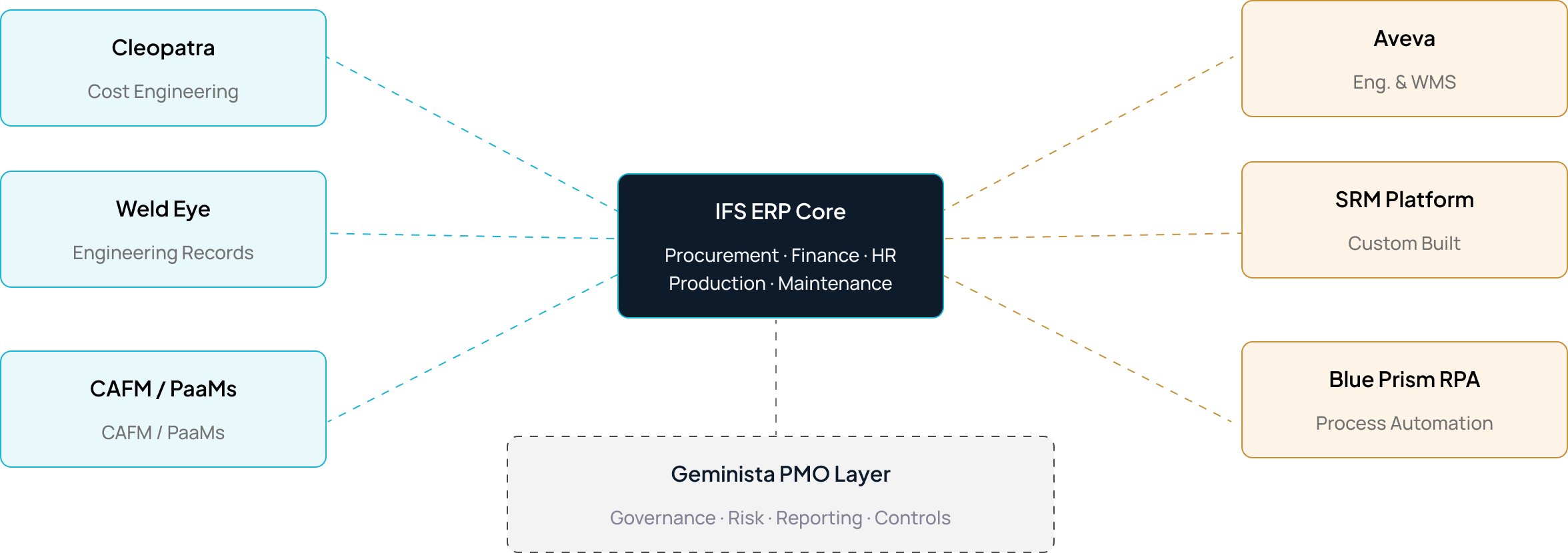
- Across the six third-party integration workstreams — covering cost engineering, engineering design, facility management, warehouse management, and welding operations — were each governed through a dedicated interface management protocol. Each integration had its own scope document, testing plan, acceptance criteria, and escalation pathway.
Custom Development Oversight:
- The SRM platform — a bespoke application designed to streamline supplier onboarding, PO lifecycle management, and vendor performance — was governed as a software development project within the overall programme, with stage gates aligned to the ERP go-live milestones.
ERP Core Programme:
- The IFS ERP implementation was managed as the programme backbone, with dependency-aware scheduling ensuring that integration testing, data migration, and UAT activities were sequenced to protect go-live timelines.
RPA Programme:
- Across the six third-party integration workstreams — covering cost engineering, engineering design, facility management, warehouse management, and welding operations — were each governed through a dedicated interface management protocol. Each integration had its own scope document, testing plan, acceptance criteria, and escalation pathway.
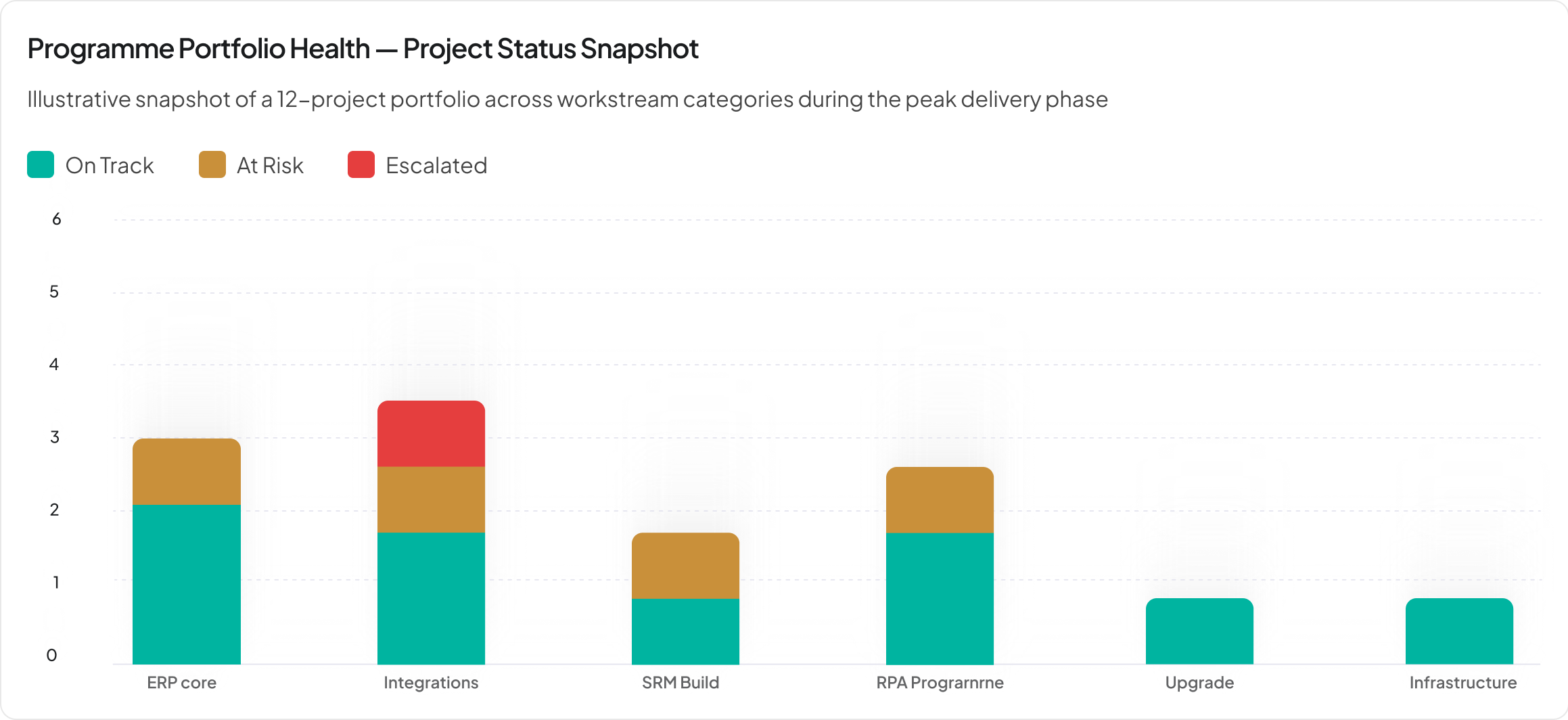
Architecture View
ERP Integration Ecosystem
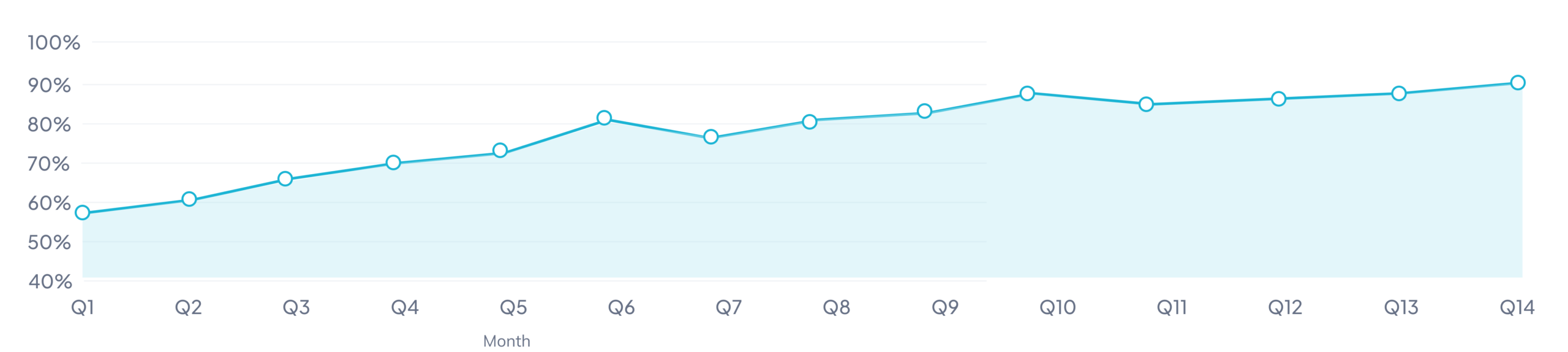
Milestone Delivery Rate — Programme Lifecycle
Percentage of milestones delivered on or ahead of schedule, by quarter
Programme Challenges
- Full IFS ERP implementation across all core modules completed, with a structured upgrade executed subsequently with zero production disruption
- Six third-party integrations delivered and accepted, enabling seamless data flow between engineering, operations, finance, and maintenance functions
- Custom SRM platform designed, built, and deployed — integrated with IFS to automate supplier onboarding and PO lifecycle management
- Enterprise RPA programme delivered, automating targeted processes across HR, Finance, and Operations departments
- Vendor SLA non-adherence reduced by 20% through structured supplier scorecards and governance checkpoints
- Steering committee reporting to board and joint venture leadership maintained throughout, ensuring complete executive visibility

Founding Team Experience.
This engagement was led by a Geminista founding advisor in a senior embedded role prior to the establishment of Geminista. The methodologies, governance frameworks, and delivery approaches applied are the proven foundation Geminista brings to client engagements today.
Case Studies

Financial Services / Banking
200 Processes. Six Months. Zero Disruption. Extending to 400+.

Government & Public Transport
Enterprise Process Automation in a Smart City Transport Authority

Central Banking & Financial Regulation
Process Automation in a Central Banking Environment: Precision, Compliance, and Control